Planetary Biology
 Local Resources
Hab. Zone Candidates
HZ Candidates feed Get our data feed for the most promising exoplanets
exoExplorer Planets
exoExplorer
Forums
Astronomical
Circumstances chapter

planetary biology chart
Planetary Biology Chart


 Exoplanet Search
Anglo-Austral. Search
Cal/Carnegie Search
Exo. Encyclopedia
Exoplanets (Paris Obs.)
Exosolar.net
Geneva Extrasolar
Planet Quest
Simbad Astro Database

 Degree Programs
Astrobio: ASU
Astrobio: U of Col.
Astrobio: U of Glam.
Astrobio: UCLA
Astrobio: Penn State
Astrobio: U of Rhode I
Astrobio: U of Wash.

Biogeochem: ASU
Geobiology: Caltech
Biogeochem: Cornell U
Biogeochem: UC Davis
Biogeochem: U of FL
Biogeochem: Indiana U
Biogeochem: U of KY
Biogeochem: UCLA
Biogeochem: Rutgers U
Biogeochem: Stanford U
Biogeochem: U Victoria

ExoAstro: UC Berkeley
ExoAstro: UC Santa Cruz
ExoAstro: SFSU
ExoAstro: U of Geneva

 News Resources
EurekAlert
European Space Agency
JPL News
MarsNews
NASA News and Events
NASA Watch
National Science Foundation
Planetary Society News
PlanetQuest
Universe Today

 Blogs
Alien Realities
Astrobiology.net
ScienceBlogs Home
Centauri Dreams Blog
Cosmic Variance
Planetary Society Blog
ScienceBase Blog
SpaceNews Blog
SpaceScan Blog

Evolution Blogs
EvolutionBlog
The Loom
The Panda's Thumb
Pharyngula
Evolving Thoughts

 Journals
Astrobiology Journal
Astrobiology Magazine
Biogeochemistry
Biogeosciences
Earth & Planetary. Sci.
Earth System Science
Evolutionary Biology
Icarus
Planetary & Space Sci.

 Search Services
Find scholarly papers at Scirus.com

Find scholarly papers with Google Scholar


 Top Picks from planetarybiology.com's exoExplorer Planets
Untitled Document

Untitled Document

Untitled Document
Last update
2008-05-08
55
Candidates
Last update
2008-05-08
28
Residents
RankPlanet NamePlanet Mass (J)Planet Semiaxis (AU)Orbital Zone
1Gl 581 b0.04920.041habitable
255 Cnc f0.1440.781habitable
3HD 20367 b1.071.25habitable
4HD 155358 c0.5041.224habitable
5HD 147513 b11.26habitable
 Exoplanet Habitable Zone Candidates, and exoExplorer Planets

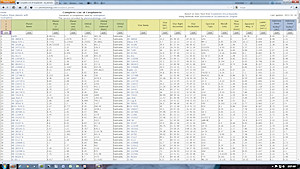
most promising exoplanets The Exoplanet Habitable Zone Candidates and the exoExplorer Planets pages tabulate the exoplanets that are the most promising candidates for life. For each listed candidate, the Exoplanet Habitable Zone Candidates page presents an estimation of the host star's habitable zone migration history and the exoplanet's residency therein.

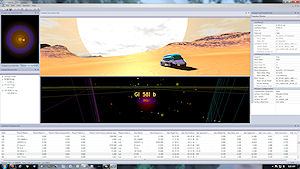
The exoExplorer Planets page estimates current habitable zone circumstances for all known exoplanets. The upcoming exoExplorer application will draw upon the data in this list for virtual voyages to the exoplanets.

For raw data, these pages use the latest listings from the frequently-updated Exoplanets Encyclopaedia. The data then are crunched here to determine key characteristics for each planet.

 Planetary Biology and other scientific disciplines that contribute to the science of astrobiology

Click for a larger image.What is planetary biology and how does this science fit into the overall thinking about life on worlds – including Earth and others?

Planetary biology is a whole world systems science. That is, the fundamental operational unit is the whole planet. Planetary biology is an integrated science that draws upon several useful sciences. The planetary biology perspective supports our efforts to understand how the activities of life (enterprising objects*) interact with and influence the operations and characteristics of the whole planet. For example, how can the collective activities of enterprising objects influence a planet's atmosphere?

The diagram at left shows the arrangement of various scientific disciplines that are useful in planetary biology. Out of necessity, it uses Earth as the basic organizational template. Given that life on Earth churns the surface, the oceans and the atmosphere in a variety of chemical ways, and produces many interesting chemical results, this diagram prominently includes chemistry-related disciplines. We see on our planet that the chemistry of life (biochemistry) can powerfully exploit the chemistry of the physical planet (geochemistry) to produce remarkable environmental outcomes (biogeochemistry).

Planetary biology incorporates ecological principles along with biogeochemistry in an effort to understand the sensible organizational structure and dynamics of a planet's enterprising occupants. Ultimately, this synthesis provides a useful analytical framework toward understanding the collective, long-term consequences of a world’s global biogeochemical activities.

The continuing discoveries of exoplanets (exoplanet astronomy) provide exciting new platforms upon which to contemplate possibilities for life in the galaxy. The application of the principles of planetary biology onto these new worlds yields the hopeful science of astrobiology – giving wings of substance and reason to our spirited quest to better know our universe and ourselves.

*enterprising objects: defined and used on this site as an alternative to the traditional term, “life”. An enterprising object is a generic object that has the following properties: 1) a physical object that can be characterized as being composed of complex operational systems; 2) self-maintaining; 3) exploitive, with the result of supporting the self-maintenance component of the system.

 
 exoExplorer
exoExplorer
exoExplorer
 Newsfeeds
Astrobiology Magazine
Mercury's Iron Snow
Oceans Gasping for Breath
Pulses to Find Planets
Asteroid BB Gun
Laser Insight into Gas Giants
Testing Times for Robotic Explorers
Solar System Bounce
Earth's Late Veneer
Is There Life on Mars? Ask a Magnet.
Mapping Mars from Wet to Dry
EurekAlert! - Space and Planetary Science
CU-Boulder team to build $34 million instrument package for environmental satellite
NASA's GLAST gets shades, blankets for the beach
Archaeologist uses satellite imagery to explore ancient Mexico
Euro Science Open Forum 2008 online media registration deadline ends June 30
Astronaut health on moon may depend on good dusting
Satellite communications by laser
Hot climate could shut down plate tectonics
Texting costs are 'out of this world'
A molecular thermometer for the distant universe
Scientists endure Arctic for last campaign prior to CryoSat-2 launch
BG - Latest Articles
Colimitation of decomposition by substrate and decomposers – a comparison of model formulations
Effects of increased atmospheric CO2 on small and intermediate sized osmotrophs during a nutrient induced phytoplankton bloom
Miniaturized biosignature analysis reveals implications for the formation of cold seep carbonates at Hydrate Ridge (off Oregon, USA)
Multiple quality tests for analysing CO2 fluxes in a beech temperate forest
Build-up and decline of organic matter during PeECE III
Biochemical characteristics and bacterial community structure of the sea surface microlayer in the South Pacific Ocean
Geomicrobiology Journal: Articles recently published in
Lipid Biomarker Patterns of Phosphogenic Sediments from Upwelling Regions
Photosynthesis, Respiration and Exopolymer Calcium-Binding in Biofilm Calcification (Westerhöfer and Deinschwanger Creek, Germany)
The Mycobiont Role in Crustose Lichen Expansion on Cobbles in the Negev Desert
Molecular Evidence for Bacterial Mediation of Calcite Formation in Cold High-Altitude Caves
Factors Affecting Methylmercury Levels in Surficial Tailings from Historical Nova Scotia Gold Mines
Further Readings in Geomicrobiology


PHP Powered
planetarybiology.com, since 1998

Copyright© 2008 by Tom E. Morris. All rights reserved.
Academic affiliation: Tom E. Morris, Division of Natural Sciences at Fullerton College
Newsfeeds powered by rss2html
   
Untitled Document 1